Horse
| Domestic Horse | ||||||||||||||
|---|---|---|---|---|---|---|---|---|---|---|---|---|---|---|
 | ||||||||||||||
| Conservation status | ||||||||||||||
| Domesticated | ||||||||||||||
| Scientific classification | ||||||||||||||
| ||||||||||||||
| Binomial name | ||||||||||||||
| Equus caballus Linnaeus, 1758 | ||||||||||||||
| Synonyms | ||||||||||||||
| Equus ferus caballus (see text) |
The horse (Equus caballus) is a large odd-toed ungulate mammal, one of ten modern species of the family Equidae.
Horses have long been among the most economically important domesticated animals; however their importance has declined with the introduction of mechanization. The horse is a prominent figure in the ideals of religion, mythology, and art, as well as playing an important role in transportation, agriculture, and warfare.
Most horses perform work such as carrying humans on their backs or are harnessed to pull objects such as carts or plows. However, hundreds of distinct horse breeds were developed, allowing horses to be specialized for certain tasks; lighter horses for racing or riding, heavier horses for farming and other tasks requiring pulling power. Some horses, such as the miniature horse, can be kept as pets. In some societies, horses are a source of food, both meat and milk; in others it is taboo to consume these products. In industrialized countries, horses are predominantly kept for leisure and sporting pursuits, while in other parts of the world they are used as working animals.
Because horses and humans have lived and worked together for thousands of years, an extensive specialized vocabulary has arisen to describe virtually every horse behavioral and anatomical characteristic with a high degree of precision.
Biology


Horse anatomy is described by a large number of horse specific terms, as illustrated by the chart to the right. Specific terms also describe horses of various ages, colors and breeds.
Age
Depending on breed, management and environment, the domestic horse today has a life expectancy of 25 to 30 years. It is uncommon, but a few horses live into their 40s, and, occasionally, beyond. The oldest verifiable record was "Old Billy," a horse that lived in the 19th century to the age of 62.[1] In modern times, Sugar Puff, who had been listed in the Guinness Book of World Records as the world's oldest then-living pony, died at age 56.[2]
Regardless of a horse's actual birthdate, for most competition purposes, horses are considered a year older on January 1 of each year in the northern hemisphere and August 1 in the southern hemisphere. The exception is endurance riding, where the minimum age to compete is based on the horse's actual calendar age.
The following terminology is used to describe horses of various ages:
- Foal: a horse of either sex less than one year old. A nursing foal is sometimes called a suckling and a foal that has been weaned is called a weanling. Most domesticated foals are weaned at 4-6 months of age.
- Yearling: a horse of either sex that is between one and two years old.
- Colt: a male horse under the age of four.
- Filly: a female horse under the age of four.
- Mare: a female horse four years old and older.
- Stallion: a non-castrated male horse four years old and older. Some people, particularly in the UK, refer to a stallion as a "horse." A Ridgling or "Rig" is a stallion which has an undescended testicle. If both testicles are not descended, the horse may appear to be a gelding, but will still behave like a stallion.[3]
- Gelding: A castrated male horse of any age, though for convenience sake, many people also refer to a young gelding under the age of four as a "colt."[4]
In horse racing the definitions of colt, filly, mare, and stallion or horse may differ from those given above. In the United Kingdom, Thoroughbred horse racing defines a colt as a male horse less than five years old and a filly as a female horse less than five years old.[citation needed] In the USA, both Thoroughbred racing and harness racing defines colts and fillies as four years old and younger.[5]
A very rough estimate of a horse's age can be made from looking at its teeth.
Size
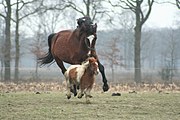
The English-speaking world measures the height of horses in hands, abbreviated "h" or "hh," and is measured at the highest point of an animal's withers. One hand is 4 inches, or 10.16 cm. Intermediate heights are defined by hands and inches, rounding to the lower measurement in hands, followed by a decimal point and the number of additional inches between 1 and 3. Thus a horse described as 15.2 hh tall, means it is 15 hands, 2 inches, or 62 inches/1.57 m in height.[4]
The size of horses varies by breed, but can also be influenced by nutrition. The general rule for cutoff in height between what is considered a horse and a pony at maturity is 14.2 hands (147 cm, 58 inches) as measured at the withers. An animal 14.2h or over is usually considered a horse and one less than 14.2h is a pony.[6]
However, there are exceptions to the general rule. Some smaller horse breeds who typically produce individual horses both under and over 14.2h are considered "horses" regardless of height. Likewise, some pony breeds, such as the Pony of the Americas or the Welsh pony, share some features of horses and individual animals may occasionally mature at over 14.2h, but are still considered ponies.
The difference between a horse and pony is not simply a height difference, but also a difference in phenotype or appearance. There are noticeable differences in conformation and temperament. Ponies often exhibit thicker manes, tails and overall coat. They also have proportionally shorter legs, wider barrels, heavier bone, shorter and thicker necks, and short heads with broad foreheads. They often have calmer temperaments than horses and also a high level of equine intelligence that may or may not be used to cooperate with human handlers.[6]
Light riding horses such as Arabians, Morgans, or Quarter Horses usually range in height from 14.0 (142 cm) to 16.0 hands (163 cm) and can weigh from 386 kilograms to about 540 kg (850 to 1200 lb). Larger riding horses such as Thoroughbreds, American Saddlebreds or Warmbloods usually start at about 15.2 hands (157 cm) and often are as tall as 17 hands (172 cm), weighing from 500 kg to 680 kg (1100 lb to 1500 lb). Heavy or draft horses such as the Clydesdale, Belgian, Percheron, and Shire are usually at least 16.0 (163 cm) to 18.0 hands (183 cm) high and can weigh from about 680 kg up to about 900 kg (1500 lb to 2000 lb). While ponies cannot be taller than 14.2h (147 cm), they may be much smaller, down to the Shetland pony at around 10 hands (102 cm),[7] and the Falabella which can be no taller than 32 inches (78 cm), the size of a medium-sized dog. However, while many miniature horse breeds are small as or smaller than a shetland pony, because they are bred to have a horse phenotype (appearance), their breeders and registries classify them as very small horses rather than ponies.
The largest horse in history was a Shire horse named Sampson, later renamed Mammoth, foaled in 1846 in Bedfordshire, England. He stood 21.2½ hands high (i.e. 7 ft 2½ in or 2.20 m ), and his peak weight was estimated at over 3,300 lb (approx 1.5 tonnes). The current record holder for the world's smallest horse is Thumbelina, a fully mature miniature horse affected by dwarfism. She is 17 inches tall and weighs 60 pounds.[8]
Colors and markings

Horses exhibit a diverse array of coat colors and distinctive markings, and a specialized vocabulary has evolved to describe them. Often, one will refer to a horse in the field by its coat color first rather than by breed or by sex. In spite of the adage that "a good horse is never a bad color," flashy or unusual colors are sometimes very popular, as are horses with particularly attractive markings, such as white on all four legs. Horses of the same color may be distinguished from one another by their markings.
The genetics of horse coat colors has largely been mapped, although discussion continues about some details, particularly those regarding markings, shade variations within a color family and what creates certain variations in shading on a single horse.[9] Essentially, all horse colors begin with a genetic base of "red" (chestnut) or "black," with the addition of alleles for suppression of color, dilution of color, spotting, graying, or other effects acting upon the base colors in various combinations and varying degrees of dominance or recessivity that create the dozens of possible shades of horses.
Reproduction and development

Pregnancy lasts for approximately 335-340 days[10] and usually results in one foal (male: colt, female: filly). Twins are rare. Colts are usually carried 2-7 days longer than fillies. Females 4 years and over are called mares[11] and males are stallions.[12] A castrated male is a gelding.[13] Horses, particularly colts, may sometimes be physically capable of reproduction at approximately 18 months but in practice are rarely allowed to breed until a minimum age of 3 years, especially females.[10] Horses four years old are considered mature, though the skeleton usually finishes developing at the age of six, and the precise time of completion of development also depends on the horse's size (therefore a connection to breed exists), gender, and the quality of care provided by its owner. Also, if the horse is larger, its bones are larger; therefore, not only do the bones take longer to actually form bone tissue (bones are made of cartilage in earlier stages of bone formation), but the epiphyseal plates (plates that fuse a bone into one piece by connecting the bone shaft to the bone ends) are also larger and take longer to convert from cartilage to bone as well. These plates convert after the other parts of the bones do but are crucial to development.
Depending on maturity, breed and the tasks expected, young horses are usually put under saddle and trained to be ridden between the ages of two and four. Although Thoroughbred and American Quarter Horse race horses are put on the track at as young as two years old in some countries (notably the United States), horses specifically bred for sports such as show jumping and dressage are generally not entered into top-level competition until a minimum age of four years old, because their bones and muscles are not solidly developed, nor is their advanced training complete. For endurance riding competition, horses may not compete until they are a full 60 calendar months (5 years) old.
Anatomy
Skeletal system

Horses have, on average, a skeleton of 205 bones.[14] A significant difference in the bones contained in the horse skeleton, as compared to that of a human, is the lack of a collarbone--their front limb system is attached to the spinal column by a powerful set of muscles, tendons and ligaments that attach the shoulder blade to the torso. The horse's legs and hooves are also unique, interesting structures. Their leg bones are proportioned differently from those of a human. For example, the body part that is called a horse's "knee" is actually the carpal bones that correspond to the human wrist. Similarly, the hock, contains the bones equivalent to those in the human ankle and heel. The lower leg bones of a horse correspond to the bones of the human hand or foot, and the fetlock (incorrectly called the "ankle") is actually the proximal sesamoid bones between the cannon bones (a single equivalent to the human metacarpal or metatarsal bones) and the proximal phalanges, located where one finds the "knuckles" of a human. A horse also has no muscles in its legs below the knees and hocks, only skin and hair, bone, tendons, ligaments, cartilage, and the assorted specialized tissues that make up the hoof (see section hooves, below).[4]
Digestion

A horse is a herbivore with a digestive system adapted to a forage diet of grasses and other plant material, consumed regularly throughout the day, and so they have a relatively small stomach but very long intestines to facilitate a steady flow of nutrients. A 1000 pound horse will eat between 15 and 25 pounds (approximately 7-11 kg) of food per day and, under normal use, drink 10 to 12 gallons (about 38-45 litres) of water. Horses are not ruminants, so they have only one stomach, like humans, but unlike humans, they can also digest cellulose from grasses due to the presence of a "hind gut" called the cecum, or "water gut," that food goes through before reaching the large intestine. Unlike humans, horses cannot vomit, so digestion problems can quickly spell trouble, with colic a leading cause of death.
Teeth

Horses are adapted to grazing. In an adult horse, there are 12 incisors (six upper and six lower), adapted to biting off the grass or other vegetation, at the front of the mouth. There are 24 teeth adapted for chewing, the premolars and molars, at the back of the mouth. Stallions and geldings have four additional teeth just behind the incisors, a type of canine teeth that are called "tushes." Some horses, both male and female, will also develop one to four very small vestigial teeth in front of the molars, known as "wolf" teeth, which are generally removed because they can interfere with the bit.
There is an empty interdental space between the incisors and the molars where the bit rests directly on the bars (gums) of the horse's mouth when the horse is bridled.
The incisors show a distinct wear and growth pattern as the horse ages, as well as change in the angle at which the chewing surfaces meet. The teeth continue to erupt throughout life as they are worn down by grazing, and while the diet and veterinary care of the horse can affect the rate of tooth wear, a very rough estimate of the age of a horse can be made by looking at its teeth.[4]
Hooves
- See also: Horseshoe and Farrier
The critical importance of the feet and legs is summed up by the traditional adage, "no foot, no horse." The horse hoof begins with the distal phalanges, the equivalent of the human fingertip or tip of the toe, surrounded by cartilage and other specialized, blood-rich soft tissues such as the laminae, with the exterior hoof wall and horn of the sole made essentially of the same material as a human fingernail. The end result is that a horse, weighing on average 1,000 pounds, travels on the same bones as a human on tiptoe. For the protection of the hoof under certain conditions, some horses have horseshoes placed on their feet by a professional farrier. The hoof continually grows, just like a large fingernail, and needs to be trimmed (and horseshoes reset, if used) every six to eight weeks.
Senses

The senses of a horse are generally superior to those of a human. As prey animals, they must be aware of their surroundings at all times. They have very large eyes (among land animals only the ostrich has a larger eye), with excellent day and night vision, though they may have a limited range of color vision. The side positioning of the eyes gives the horse a wide field of vision of about 350°.[15] While not color-blind, studies indicate that they have difficulty distinguishing greens, browns and grays. Their hearing is good, and the pinna of their ears can rotate a full 360 degrees in order to pick up sound from any direction. Their sense of smell, while much better than that of humans, is not their strongest asset; they rely to a greater extent on vision.
A horse's sense of balance is outstanding; the cerebellum of their brain is highly developed and they are very aware of terrain and placement of their feet. Horses' sense of touch is better developed than many people think; they immediately notice when a fly or mosquito lands on them, even before the insect attempts to bite. Their sense of taste is well-developed in order to determine the nature of the plants they are eating, and their prehensile lips can easily sort even the smallest grains. Horses will seldom eat most poisonous plants or spoiled food unless they have no other choices, although a few toxic plants have a chemical structure that appeals to animals, and thus poses a greater risk of being ingested.
- See also: Muscular system of the horse, Respiratory system of the horse, and Circulatory system of the horse
Gaits
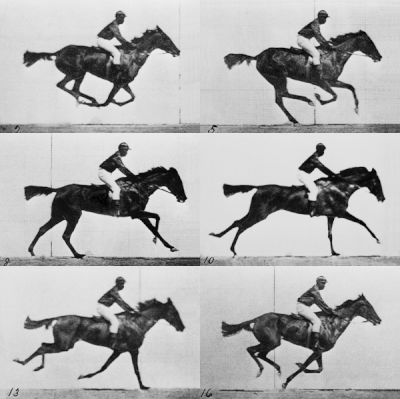
All horses move naturally with four basic gaits: the walk, trot or jog, canter or lope, and gallop.[16]
Besides these basic gaits, some horses pace, instead of trot.[17] In addition, there are many "ambling" gaits such as the slow gait, rack, fox trot running walk, and tölt. These special gaits are often found in specific breeds, often referred to as "gaited" horses because they naturally possess additional gaits that are approximately the same speed as the trot but smoother to ride. Technically speaking, "gaited horses" replace the standard trot (which is a 2 beat gait) with one of the four beat gaits.[18]
Horse breeds with additional gaits that often occur naturally include: the Tennessee Walking Horse which naturally performs a running walk; the American Saddlebred which can be trained to exhibit a slow gait and the rack; Paso Fino, which has two ambling gaits, the paso corto and paso largo; the Peruvian Paso, which exhibits the paso llano, and sobreandando; and Icelandic horses which are known for the tölt. The fox trot is found in several breeds, most notably the Missouri Foxtrotter. Standardbreds, depending on bloodlines and training, may either pace or trot.[18]
Behavior
Horses are prey animals with a well-developed fight-or-flight instinct. Their first response to threat is to startle and usually flee, although they are known to stand their ground and defend themselves or their offspring in cases where flight is not possible, or when their young are threatened. They also tend to be curious; when startled, they will often hesitate an instant to ascertain the cause of their fright, and may not always flee from something that they perceive as non-threatening. Through selective breeding, some breeds of horses are quite docile, particularly certain large draft horses. However, most light horse riding breeds were developed for speed, agility, alertness and endurance; natural qualities that extend from their wild ancestors.[19]
Horses are herd animals, with a clear hierarchy of rank, led by a dominant animal (usually a mare). Horses are also social creatures who are able to form companionship attachments to their own species and to other animals, including humans. They communicate in various ways, including vocalizations such as nickering or whinnying, mutual grooming, and body language. Many horses will become difficult to manage if they are isolated. When this behavior occurs while being handled by human, the horse is called "herd-bound". However, through proper training, it is possible to teach any horse to accept a human as a type of companion, and thus be comfortable away from other horses.
When confined with insufficient companionship, exercise or stimulation, horses may develop stable vices, an assortment of bad habits, mostly psychological in origin, that include wood chewing, wall kicking, "weaving" (rocking back and forth) and other problems.[20]
Sleep patterns

Horses are able to sleep both standing up and lying down. They are able to doze and enter light sleep while standing, an adaptation from life as a prey animal in the wild. Lying down makes an animal more vulnerable to predators.[21] Horses are able to sleep standing up because a "stay apparatus" in their legs allows them to relax their muscles and doze without collapsing.[22][23]
Unlike humans, horses do not sleep in a solid, unbroken period of time. They obtain sleep by means of many short periods of rest. Horses may spend anywhere from four to fifteen hours a day in standing rest, and from a few minutes to several hours lying down. Total sleep time in a day may range from several minutes to a couple of hours.[24] Horses require approximately two and a half hours of sleep, on average, in a 24-hour period. Most of this sleep occurs in many short intervals of about 15 minutes each.[25]
Horses must lie down to reach REM sleep. They only have to lie down for an hour or two every few days to meet their minimum REM sleep requirements.[24] However, if a horse is never allowed to lie down, after several days it will become sleep-deprived, and in rare cases may suddenly collapse as it involuntarily slips into REM sleep while still standing.[26] This condition differs from narcolepsy, though horses may also suffer from that disorder.[25]
Horses sleep better when in groups because some animals will sleep while others stand guard to watch for predators. A horse kept entirely alone will not sleep well because its instincts are to keep a constant eye out for danger.[24]
Temperament
- See also: Horse behavior
Horses are mammals, and as such are all "warm-blooded" creatures, as opposed to reptiles, which are cold-blooded. However, these words have developed a separate meaning in the context of equine description, used to describe temperament, not body temperature. For example, the "hot-bloods", such as race horses, exhibit more sensitivity and energy, while the "cold-bloods," such as most draft breeds, are quieter, calmer creatures.[27]
"Hot" bloods

The "hot blooded" breeds have a level of sensitivity and intelligence that enables quick learning with the potential for greater communication and cooperation with their riders. However, their intelligence also allows them to learn bad habits as quickly as good ones. Because of this, they also can quickly lose trust in a poor rider and do not tolerate inept or abusive training practices.
"Oriental" breeds such as the Akhal-Teke, Barb, and Arabian horse and the now-extinct Turkoman horse gained the title of "hot bloods" for their temperament, characterized by sensitivity, keen awareness, athleticism, and energy. European breeders wished to infuse these traits into their best racing and light cavalry horses and thus imported a number of oriental horses into Europe. These traits, combined with the dense but more aesthetically refined bone structure of the oriental-type horse, were used as the foundation of the Thoroughbred breed. Other than the oriental breeds and the Thoroughbred, there are no other breeds given the classification "hot blooded" today.[27]
"Cold" bloods

Muscular and heavy draft horses are known as "cold bloods," as they have been bred, not only for strength, but also to have the calm, steady, patient temperament needed to pull a plow or a heavy carriage full of people. They are sometimes nicknamed "gentle giants" because of their placid dispositions.
There are well over a dozen well-known draft breeds, and many more rarer breeds developed in various regions of the world that were adapted to local conditions. Some breeds are lighter and livelier, developed to pull carriages or to plow large fields in drier climates. Others are slower and more powerful, bred to plow fields with heavy, clay-based soils. One of the most common draft breeds is the Belgian. The largest is the Shire. Clydesdales, with their common coloration of a bay or black coat, with white legs and long-haired, "feathered" fetlocks, are one of the most easily recognized.[27]
Warmbloods

The term "warmblood" has two different meanings today; the more common modern meaning refers to a specific subset of horse breeds, and the other, older meaning refers simply to horses of a moderate temperament. The term "warm blood," up through approximately the 1970s, originally referred to any cross of "cold blooded" draft horses on "hot blooded" Thoroughbreds or Arabians. Examples included breeds such as the Irish Draught horse or the Cleveland Bay, and sometimes also referred to the "Baroque horses" used for classical dressage, such as the Lipizzan or Andalusian. Sometimes the term was even used to refer to breeds of light riding horse other than Thoroughbreds or Arabians, such as the Morgan horse.[27]
Today the term "warmblood" usually refers to a group of sport horse breeds that have dominated the Olympic Games and World Equestrian Games in Dressage and Show Jumping since the 1950s. The "Warmblood" breeds began when European carriage and war horses were crossed with oriental horses or Thoroughbreds, producing a tall riding horse with more refinement than a draft horse, but greater size and more phlegmatic temperament than a lighter breed.

No comments:
Post a Comment